Oct 23, 2008

I Heart Valley Art

In the wake of Paul Newman's September 26th death at the age of 83, my sentiment at his passing has been piqued by the rush of remembrances that poured from a myriad of sources: contemporaries and cohorts, filmmakers and fans, beneficiaries and bloggers alike have sung the praises of the humble Ohian-cum-silver screen star whose ingenuity in his later years became the prosperity he diffused to innumerable worthy causes.

But amongst all the positive press Paul's life received, little has been mentioned of his screen legacy - and understandably so, in light of his charitable work and how he valued it, far above his film contributions. As an ardent classic cinema fan, though, I feel his Luke and his Ben Quick, his Hud and his Hombre (okay, maybe not Hombre) are worth more than a fond farewell acknowledgment in his many obituaries. This was evidently a sentiment shared by my local Harkins Valley Art Cinema, as they recently hosted a week-long, multiple-film retrospective in Paul's honor, which I was fortunate enough to attend.

Valley Art, the oldest theatre in the state, provided a sumptuously antique feel for late-night big screen viewings of some of Paul's most popular films, including Cool Hand Luke (1967), Butch Cassidy and the Sundance Kid (1969), and 1961's gritty The Hustler. As someone who had never reveled in the grandiose spectacle of silver screen stars in such sizable glory, to witness Newman the actor - thoughtful, passionate, impossibly Adonis-like - was to see his film presence finally in proportion to his personal and social legacy: larger than life.

Harkins Valley Art donated all proceeds from the festival, more than $3,000, to Newman's Painted Turtle Camp, a multi-disease camp and family care center based in California.

Labels: , ,

May 26, 2006

Respectable Collection

There are only so many things a girl can do in a large and lonely apartment all day as she waits for her energy level to slow down and her summer job to start up. I've no cable as of yet, but I do have boxes full of books (all read, of course), stacks of last year's magazines, half-filled sketchbooks, and a refrigerator containing yogurt, orange juice, and a bottle of apple-flavored Bartleby & Jaymes that may or may not be consumable. My uber-friendly new neighbors are on vacation, my roommate took a three-week sabbatical to her hometown, and the flock of friends in my vicinity have flown to Florida for a conference that will last well into June. Je suis seule, mes amis...seule.
In the midst of all this boredom, I've come to rely quite a lot on the trusty cd case that houses my beloved collection of dvds. Movies I haven't watched in months were brought out for re-assessment, and I was definitely surprised at how much I enjoyed some of the discs I've owned for ages and never viewed:

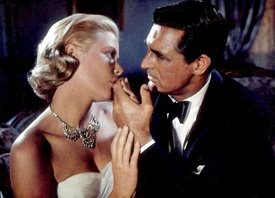
To Catch A Thief, 1955 - Grace and Cary's camraderie seems funnier, and wrought with more sexy tension, than the last few times I've sat through it. The special edition dvd that I own boasts a plethora of extra features, including a documentary on the making of the film, a short biography on the private life of Alfred Hitchcock, and a very interesting look at famed costume designer Edith Head's contributions to Paramount films during her six-decade career. This is delightfully lightweight Hitchcock at its finest....
'Do you want a leg or a breast?'


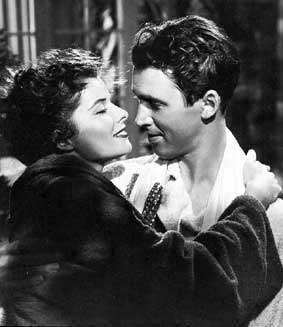
The Philadelphia Story, 1940 - This week marks the first time I watched this vividly-dialogued spitfire of a romantic comedy after having gained greater appreciation of all four leads: Cary Grant, Jimmy Stewart, George Brent, and Miss Kate the Great. Everyone from the bitter little Dinah to sour old Uncle Willie the pincher has a memorable and amusing scene, and if the pace saps for even a second (though it rarely does), you can always just marvel at all of the legendary talent squeezed into one screen. Plus, where else will you see Jimmy Stewart drunk in a wicker wheelchair?

'Can you have a drink, or will Kittredge spank?'


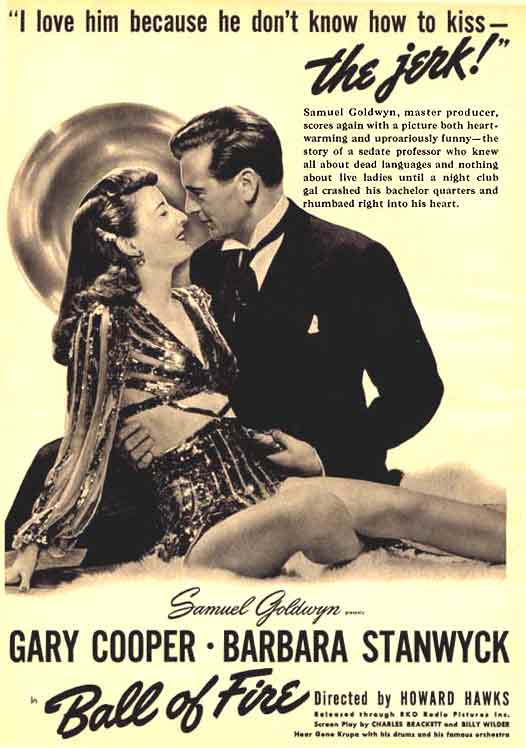
Ball of Fire, 1941 - I would be lying if I said that I've owned this movie forever, and it would most definitely be a falsehood if I claimed to never watch it: I bought it just last month and in fact, have watched it practically once a week ever since. Once you get the plot down pat with an initial viewing, Ball of Fire should be watched just to fall in love with its characters and its marvelous acting over and over again. This is the film that not only sold me on Barbara Stanwyck and her be-all, end-all seductiveness, but it endeared me completely to quiet, sensitive Gary Cooper and cemented the lyrics to "Drum Boogie" in my mind forever (Stany sings it in a number with Gene Krupa). I don't care if you've never heard of any of these cats - just Netflix it already, will ya? You won't regret it.

'This is the kind of woman that makes whole civilzations topple!'


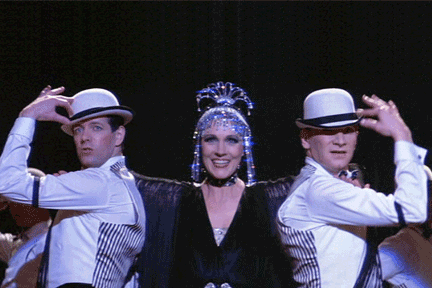
Victor Victoria, 1982 - Okay, okay, so it's not classic cinema. But V/V is nearly 25 years old, and it does feature three eminent talents that factor largely into moviemaking of the 1960's: director Blake Edwards, composer (and frequent Edwards collaborator) Henry Mancini, and the beautiful, multi-talented Julie Andrews. Set in Paris in the 1930's (perhaps this lends it its "classic movie" feel), the film follows the struggles of desperately poor young soprano Victoria Grant (Andrews), who soon meets her personal Svengali in flamboyant nightclub singer Carroll Todd (Robert Preston and his ginormous hair). His solution to Victoria's lack of employment involves a short haircut with plenty of brilliantine, disguising a non-existent Adam's apple, and James Garner's greasy gangster character falling in love with a man. That is a man, right...? Either way, Victor/Victoria is a delightful musical with a decidedly adult feel, a sparkling score, and Edwards' signature comedic shots (look for the telltale flaming umbrella).

'Well Greta, whatever he is, I think he's divine.'


What excellent films do you have in your collection that never lose their appeal?

Labels: , ,

May 7, 2006

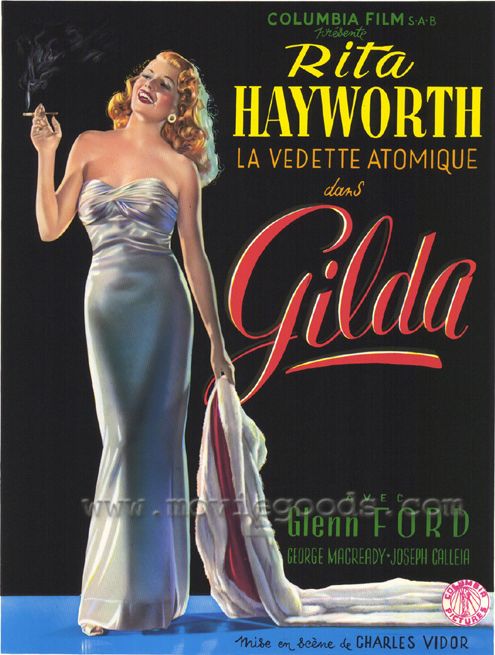
Put the Blame on Glenn-Ford, Put the Blame on Him...

When I settle in to watch a TiVo'ed episode of Turner Classic Movies' The Essentials, a program devoted to showcasing the classic films deemed absolutely necessary for fans of the silver screen, I am always a little apprehensive. I don't trust host Robert Osborne anymore; I sense that his ulterior motive is to instigate inferiority complexes upon the guest programmers and film critics he invites to the immaculate soundstage room from which he introduces movies every day, spewing off names and facts like an eccentric Zeus raining his privileged knowledge down upon viewers from his stance on the Mount Olympus of cable television. Either that, or the man's a damned fine professional, and I am but a mewling novice in the light of his staggering facility with dates, trivias and backstories....yeah. Probably moreso that last one. I just want to watch great movies though, Bobby! No one cares that you had dinner at Maureen O'Hara's house!

Okay, so Bob's an enviable cinephile. But when it comes to his selections for The Essentials, I guess I'd rather do without, choosing instead to devour wonderful, unsung films with my favorite stars, esoteric titles, and nary a chance of a DVD release, ever. This weekend's pick, Gilda, threw me for a loop - and left me looking for someone to put the blame on, besides Mame.

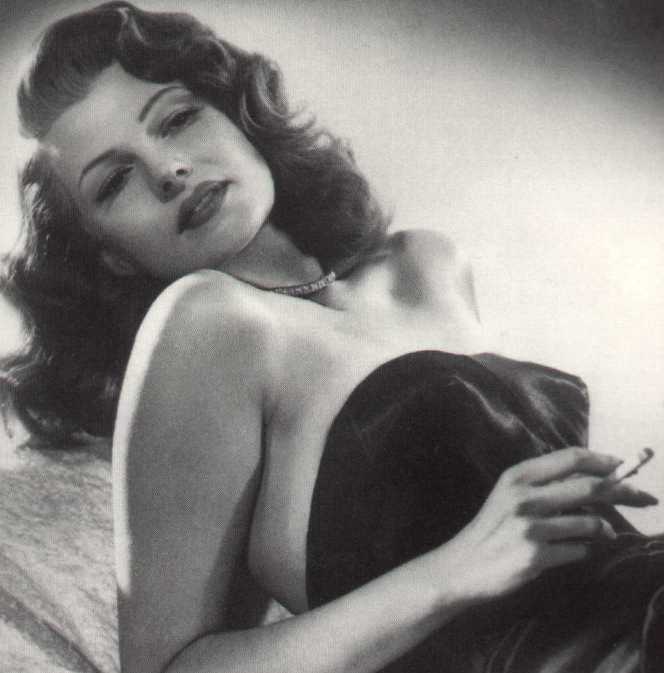
The title character is played by vivacious Rita Hayworth: she is, as always, a beautiful actress. I've always thought so, as did the innumerable GI's who adorned their bunks and barracks with her pin-ups in the years before Gilda was made - and the film uses her physical presence to its fullest advantage, her image still as dazzling today as it was sixty years ago. Glenn Ford enters the picture as an old flame of Gilda's, a young man working in a gambling house in Argentina, where the story takes place; tension arises when his character, Johnny, makes the startling discovery of Gilda's presence in the casino after all that has happened between them. It's an interesting enough storyline, but...is it an Essential?

Hayworth is smouldering and sensual, George Macready is top-notch as the sinister casino owner, and I can't complain about Glenn Ford's performance here. As for the rest of the film, though - the story's pace is uneven, the plot seems somehow secondary to the visual allure of the film, and it clocks in at nearly two hours (a quite tolerable length, had it been a tolerable movie). While the dialogue is delicious, dangerous innuendo written in true film-noir style, and the fierce love-hate relationship between Johnny and Gilda is engaging, Gilda fails to reach classic film status due to its seemingly hastily-comprised ending, which leaves much to be desired, especially after all of the tension that has built up in the first portion of the movie.

I guess I'll give good ol' Gild another try in the future, but I'm curious as to who hails this film and what elements of it they find redeeming and noteworthy. Do you consider Gilda to be a great film? What about Rita Hayworth's acting ability - in what films is it best showcased?

Labels: ,

Apr 26, 2006

Barbra Streisand Owes Me 2 hours and 23 Minutes of My Life

Because that's precisely how much time, patience, and half-attention I gave to her film Funny Lady last night. Going into it, I should have seen the red flags - the fact that it was a musical starring James Caan being the reddest of them all, probably even emblazoned with skull and crossbones - yet I pressed on defiantly, hoping at some point, I would be rewarded for my persistence; after all, I was pleasantly surprised at what a gem the prequel to this film, 1968's Funny Girl, turned out to be when I caught it last month.
The thing is, I don't think that Babs can give a poor performance. Funny Girl, Hello, Dolly!, The Way We Were - the woman and her larger-than-life voice are spectacular, and like her or not, you can't help but admit she's got a hell of a lot of talent. The plot of this movie, though - and don't argue that musicals don't need plots - can't be held afloat by even the most valiant of Streisand's efforts. She still manages to shine here, but she's the only ray of light in this seemingly never-ending, picaresque bio-pic. Two and a half hours into Funny Lady, I still didn't care about the fate of fantastically bitchy Fanny Brice, I had seen Caan lash out as the frustrated husband (complete with expletives and wall-punching, in true Sonny-Corleone style), and was totally indifferent to the fact that Omar Sharif's Nicky Arnstein had remarried a tacky Lesley-Ann Warren wannabe. I never thought I'd long for the strains of "Don't Rain on My Parade" or the sight of Babs on rollerskates again, but Funny Lady succeeded only at highlighting what a great flick its predeccesor is. People may need people, but they definitely don't need this movie.

Labels:

Apr 21, 2006

Thumbs Up for Three (well, actually just two)

A little insight on some of the fab flicks I've seen recently:

Cactus Flower (1969) What, really, can be said about a love...rectangle between Walter Matthau (shudder), Ingrid Bergman, a young Goldie Hawn fresh from Laugh-In and her skinny, nondescript beatnik neighbor? Only that it was far more entertaining than I could've hoped. Matthau is a dentist who hopes to date Hawn, but somehow, she's come under the impression that he's married - and no one wants to be a homewrecker, right? Sensing his impending loss, Matthau pleads his shy, introverted secretary (a still-flawless and amazingly comedic Bergman) to parade as his soon-to-be-ex-wife and inform Hawn that the marriage is over, leaving the delicious (shudder) dentist is up for grabs. But who ends up with whom is still being sorted out til the film's very finish. A truly classic scene: Ingrid Bergman in a dazzling blue dinner gown and mink stole, dancing freestyle among teenagers at a fashionable, free-love hippie coffee spot. Seriously, see this movie.


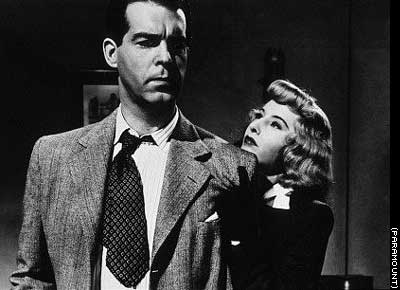
Double Indemnity (1944) Barbara Stanwyck * the dad from My Three Sons + Billy Wilder's directorial skill = film noir classic, non? Well...sort of. Double Indemnity is perhaps the kind of complex, mulitlayered film, much like Casablanca, that earns its due praise and respect upon multiple viewings, but doesn't have much clout the first time around. The plot seems simple enough: a frustrated wife (Stanwyck, in a hideous blonde wig) meets down-on-his-luck insurance salesman Walter Neff (yup, Rob, Chip & Ernie's dad) when he visits her home to inquire on the extension of the coverage of one of her husband's soon-to-expire policies. Intrigued, she realizes that if her husband were to have life insurance, she could gain a swift and sizable sum upon his death - if it's proven to be an accident. Scandal and intrigue arise as she and Neff work together to plot and execute the perfect murder. I stayed around to catch the end, but certainly not because of Stanwyck's acting; I could hardly call it a worthwhile film, but I will admit the suspense was nearly nauseating at some points throughout. Perhaps I'll give it a try in a few months and see if I can glean any new aspects to appreciate from it. Until then, though, I'll give it a double condemnation.

Yankee Doodle Dandy (1942) Before this past Tuesday evening, if you were to ask me anything about James Cagney, my response would invariably be "You dirty rat, you killed my brudda" in one horrible attempt at colorful dialect or another, because that's just one of those things I feel you're societally responsible to know - a timeless quote that you're simply born knowing to whom it's attributed. Imagine my surprise, then, upon realizing that the Yankee Doodle Dandy I'd tuned into was a good movie. Not just a decent movie, but a very good one (albeit a tad propaganda-laden, justifiable in the flagwaving months following Pearl Harbor). Who knew Cag could dance? And sing? And do comedy? And dance?! Did I mention the hoofing? Though not too similar to the vibrant, color-saturated MGM spectacles I'm used to, Dandy is just that - dandy. It's a delightful bio-pic of songwriter, actor, and stage producer George M. Cohan, and Cag pulls it off to a tee, infusing as much patriotism and enthusiasm into his character's creative forces as we'd like to imagine the real-life Cohan did. Cagney took home his only Oscar for his performance here, and I can say that as the real-live nephew of his uncle Sam, he definitely deserves it.

Labels: , , ,

Apr 11, 2006

A Secret Midnight Millionaire

Somehow, despite the fact that my weekends feel like they're only about 14 hours long, I always squeeze in some classic films I've never seen before, courtesy Turner Classic Movies' phenomenal round-the-clock lineup. Some gems I encountered this weekend:


Midnight Lace (1960) Eternally-cute Doris Day stars in what isn't her first thriller (she played opposite James Stewart in Hitchcock's 1956 The Man Who Knew Too Much), but could very well be her most memorable. Lace centers on the life of a young, elegent housewife Kit Preston (Day) and her crusty British husband (the crusty, British Rex Harrison) during their temporary stay in a London hotel. From the film's very outset, Mrs. Preston is stalked by a mysterious man who calls to her in the city's heavy fog, makes lewd phone calls to her apartment, and threatens to kill her while her husband is away. Though a bit lengthy, Midnight Lace is nonetheless a true thriller, as the suspense is made all the more taut with a startling revelation at the film's end. Oh, and John Gavin stars, looking sexy (and wooden) as ever.


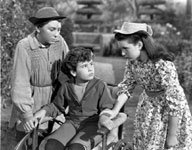
The Secret Garden (1949) Margaret O'Brien, what do I think of thee? I really don't know whether I want to wallop the diminutive diva or shower her with praise for all the performances of her preadolescent years. Evoking similar ambivalence from me is The Secret Garden, neither a terrible film nor a classic: its plotline is decent enough, and it does employ some fabulous Wizard-of-Oz-esque Technicolor sequences, quite artsy and dramatic in the middle of a dreary black-and-white setting. A notable star besides Ms. O'Brien (who will eternally be Tootie Smith, Flour-Thrower to me) is Dean Stockwell, pint-sized even at age 14, as the bedridden boy limited by his doctors' well-meaning diagnoses. Catch it if it's on, but don't go out of your way for this one, unless you love Tootie Smith.


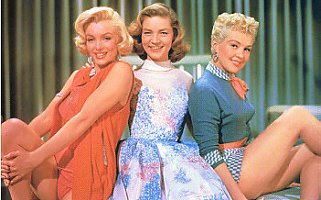
How to Marry A Millionaire (1953) Lauren Bacall plays a deliciously devious ringleader in this frothy comedy, the first ever to be shot using fabulous Cinemascope. Convinced that dollar signs are more the key to marriage than love is, she buys a first-rate luxury apartment in just the right New York neighborhood for meeting wealthy, eligible men, and shares her new digs with fellow unattached models Marilyn Monroe and Betty Grable. While it's arguable that Bacall - slim, pretty, with enough brains, tenacity, and acerbic wit to get what she wants - steals the show, Marilyn doesn't disappoint in her role as the near-sighted beauty who refuses to wear her glasses when men are around, resulting in many an upside-down book and tripped-over curb. Betty Grable's character is the only snag here, as it doesn't do anything to showcase the talent or beauty of the screen-weary blonde (although the dream sequence is hilarious). Still, this is definitely worth seeing at least once, if only for the comdey, the fashion, and the delightful and inspiring gold-digging these three screen goddesses embark upon. And don't miss William Powell and David Wayne as two of the hapless men they prey on!

Labels: ,